Year of publication
2025
Location
Brazil
Financial supporter:
Government of Brazil, Amazon Fund, blended finance sources
Period of implementation:
2024 to present
Commodities:
Sociobiodiversity products, agroforestry crops (fruits, oils, fibres)
Initiator:
MDA
Author & Publisher
FACT DIALOGUE
Overview
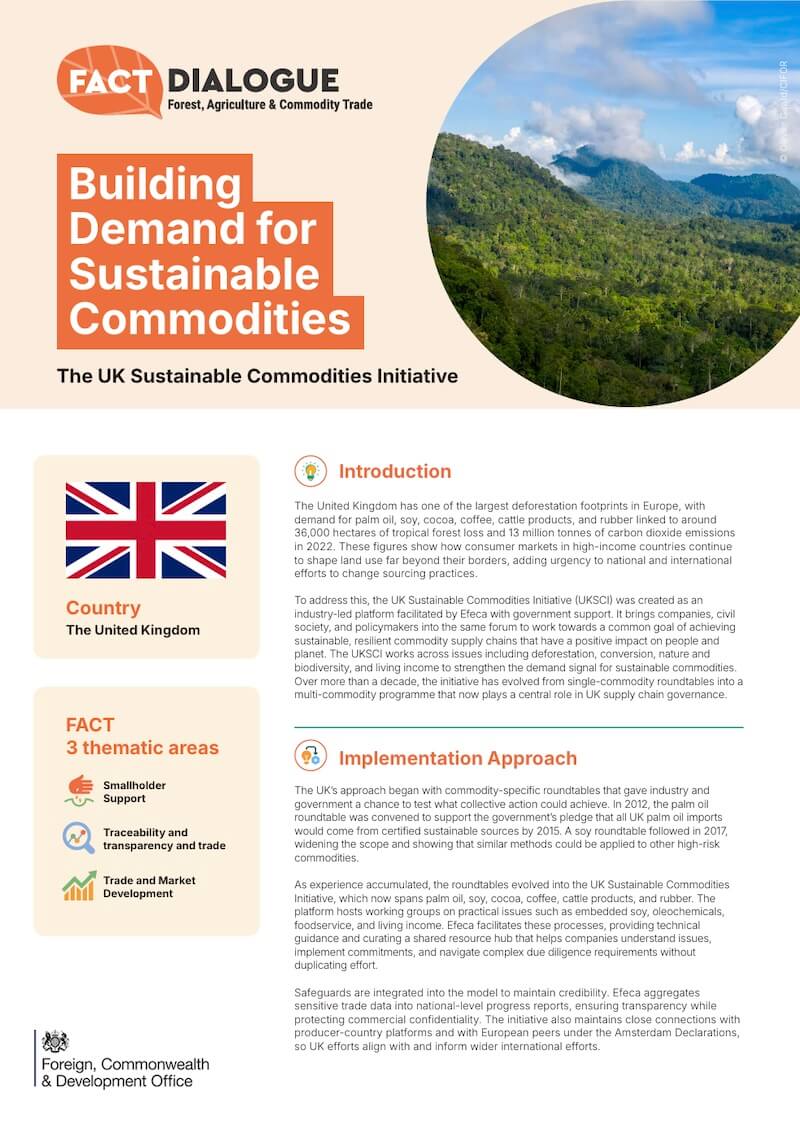
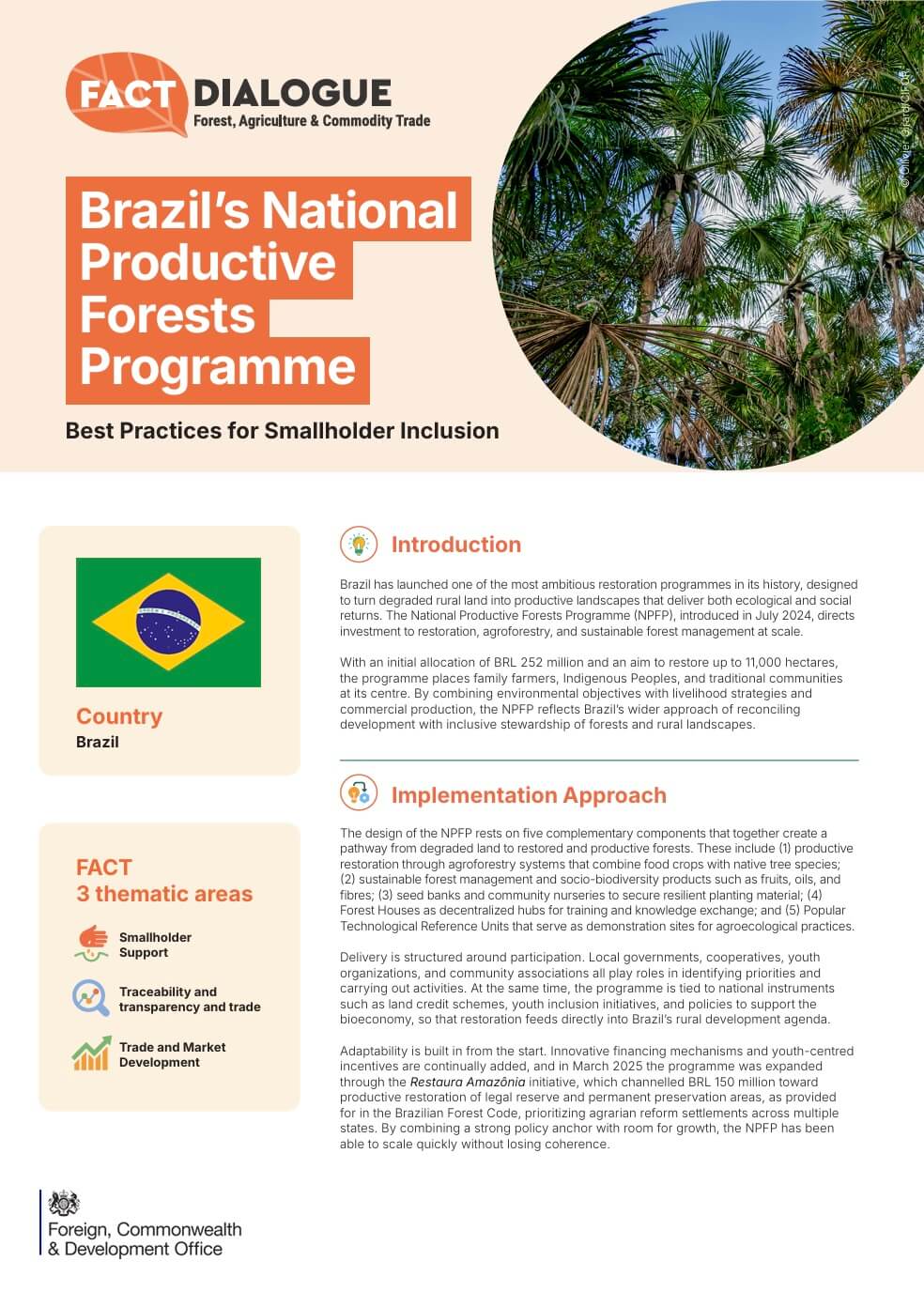
This case study examines how the National Productive Forests Programme converts degraded land into “productive restoration” by linking seed systems, community nurseries and sociobiodiversity value chains to rural income.
This programme is significant because it aligns forest restoration with economic development, not just conservation. By integrating smallholders into sociobiodiversity value chains, Brazil is demonstrating a model where ecological recovery supports rural livelihoods.
Still, scaling this model faces challenges: ensuring long-term financing, navigating land tenure issues, and guaranteeing that restored production does not inadvertently drive new deforestation pressures elsewhere.
252 million
Initial programme allocation (BRL)
Direct investment in restoration, agroforestry and sustainable forest management
11,000 hectares
targeted for productive restoration
Converting degraded land into income-generating landscapes
5
core programme components
Agroforestry systems | Socio-biodiversity value chains | Seed banks & nurseries | Forest Houses | Technological Reference Units
150 million
Additional financing through Restaura Amazônia (BRL)
Scaling restoration in legal reserve and permanent preservation areas
3
FACT pillars advanced
Smallholder Support | Trade and Market Development | Traceability and Transparency
2
years of implementation
Restoration embedded in rural development policy
In practice: From seed systems to value chains
The National Productive Forests Programme (NPFP) creates a structured pathway from degraded land to productive forests.
Community seed banks and nurseries secure resilient planting material. Forest houses operate as decentralized hubs for training and technical assistance. Agroforestry systems combine native tree species with food crops, while sociobiodiversity products – fruits, oils and fibres – are linked to cooperative value chains.
The 2025 expansion through the Restaura Amazônia initiative extends this model across multiple states, prioritizing agrarian reform settlements and mobilizing support for thousands of families.
Rather than treating restoration as a stand-alone environmental intervention, Brazil embeds it in land credit schemes, youth inclusion initiatives and bioeconomy policy – ensuring restored landscapes are economically viable.
Why this matters
Brazil’s NPFP demonstrates that restoration can scale when it is rooted in rural development and connected to functioning markets.
By aligning agroforestry production, community institutions, finance mechanisms and national monitoring systems, the programme advances smallholder inclusion while reinforcing transparency and supply chain credibility.
For deforestation-free trade systems, this model is critical: restored and managed landscapes generate the documentation, traceability and stable income streams that markets increasingly require.
In doing so, Brazil advances the FACT Roadmap across all three pillars – showing how restoration policy, when tied to value chains and local ownership, becomes both a climate strategy and an economic development strategy.