Year of publication
2025
Location
United Kingdom, with links to producer countries globally
Financial supporter:
Efeca, UK Government, industry participants, other third party sources
Period of implementation:
2012 to present
Commodities:
Palm oil, soy, cocoa, coffee, cattle, rubber
Initiator:
Efeca with industry and government support
Author & Publisher
FACT DIALOGUE
Overview
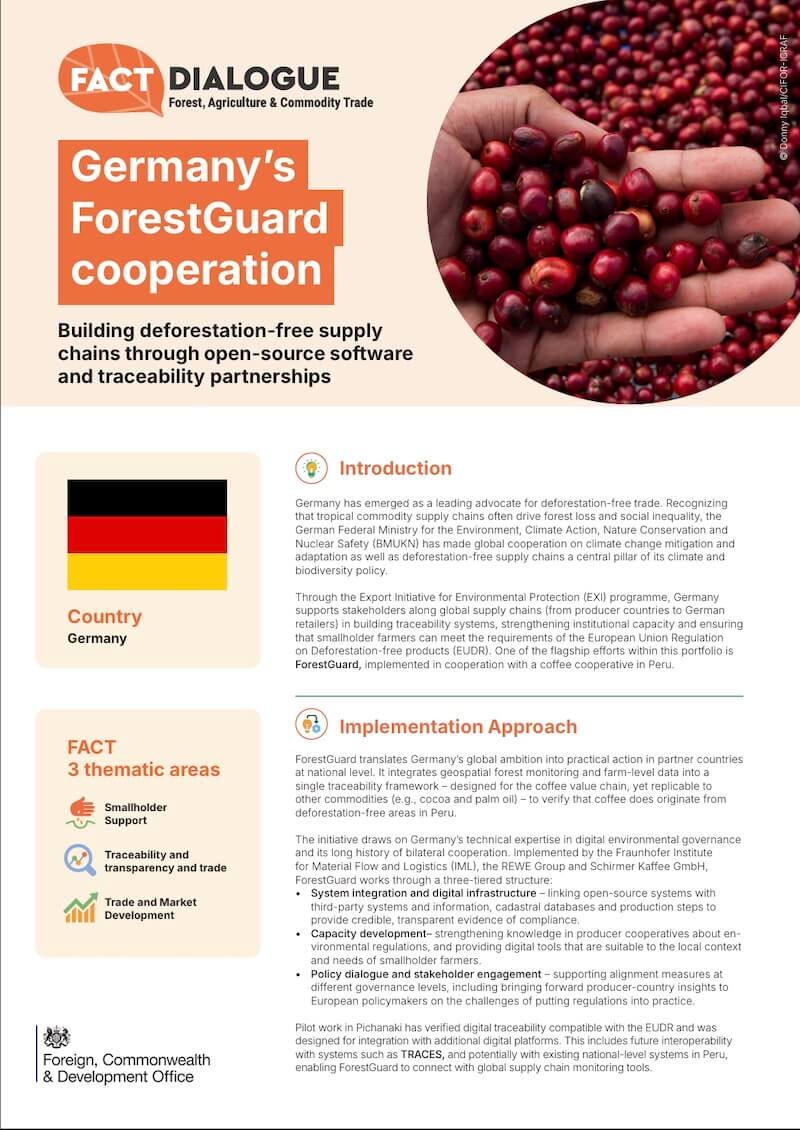
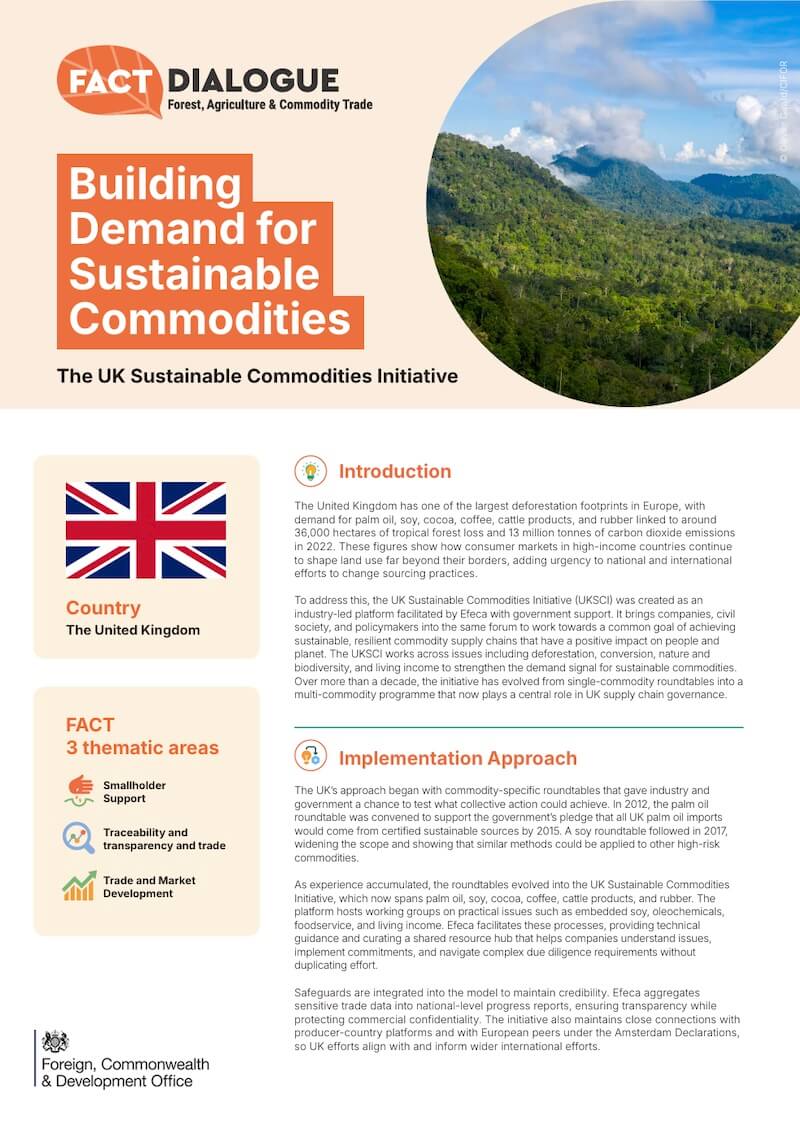
This case study profiles the UK Sustainable Commodities Initiative (UKSCI) as a coordination platform that aligns buyers, reporting and cross-commodity working groups to strengthen demand signals and traceability.
The UKSCI demonstrates how demand-side coordination can drive sustainability. By uniting large buyers and stakeholders before regulations force change, the platform builds voluntary momentum and shared infrastructure.
To remain effective, it must continue scaling participation – particularly among smaller buyers and producers – secure long-term funding, and embed compliance rather than aspiration as regulatory pressure increases.
135+
companies and industry associations engaged
Retail, feed, shipping, NGOs and government
92%
sustainable palm oil imports (2023)
Up from 16% in 2010
74%
sustainable soy supply (2023)
Up from 16% in 2017
6
major forest-risk commodities covered
Palm oil, soy, cocoa, coffee, cattle, rubber
14
years of implementation
Strengthening the UK’s demand signal for deforestation-free trade
In practice: From palm oil pledge to multi-commodity platform
The UK’s approach began with a palm oil roundtable in 2012 to support a government commitment that all UK palm oil imports would come from certified sustainable sources by 2015.
Over time, similar coordination mechanisms were applied to soy and other forest-risk commodities. What began as single-commodity roundtables evolved into a multi-commodity platform spanning palm oil, soy, cocoa, coffee, cattle products and rubber.
Efeca facilitates the platform, aggregating trade data into national progress reports while protecting commercial confidentiality – ensuring that voluntary commitments are backed by credible monitoring.
Why this matters
The UKSCI demonstrates how consumer markets can reshape global supply chains by coordinating demand.
By aligning buyers, aggregating monitoring data, and connecting with producer-country platforms and European peers, the initiative strengthens transparency and market readiness across multiple commodities.
In doing so, it advances FACT priorities on trade and markets, traceability and transparency, and smallholder-inclusive collaboration – showing how voluntary coordination can prepare the ground for regulatory compliance.