Year of publication
2025
Location
Ghana
Financial supporter:
The African Development Bank(AfDB) and Ghana Cocoa Board
Period of implementation:
2018–2025
Commodities:
Cacao
Initiator:
Government
Author & Publisher
FACT DIALOGUE
Overview
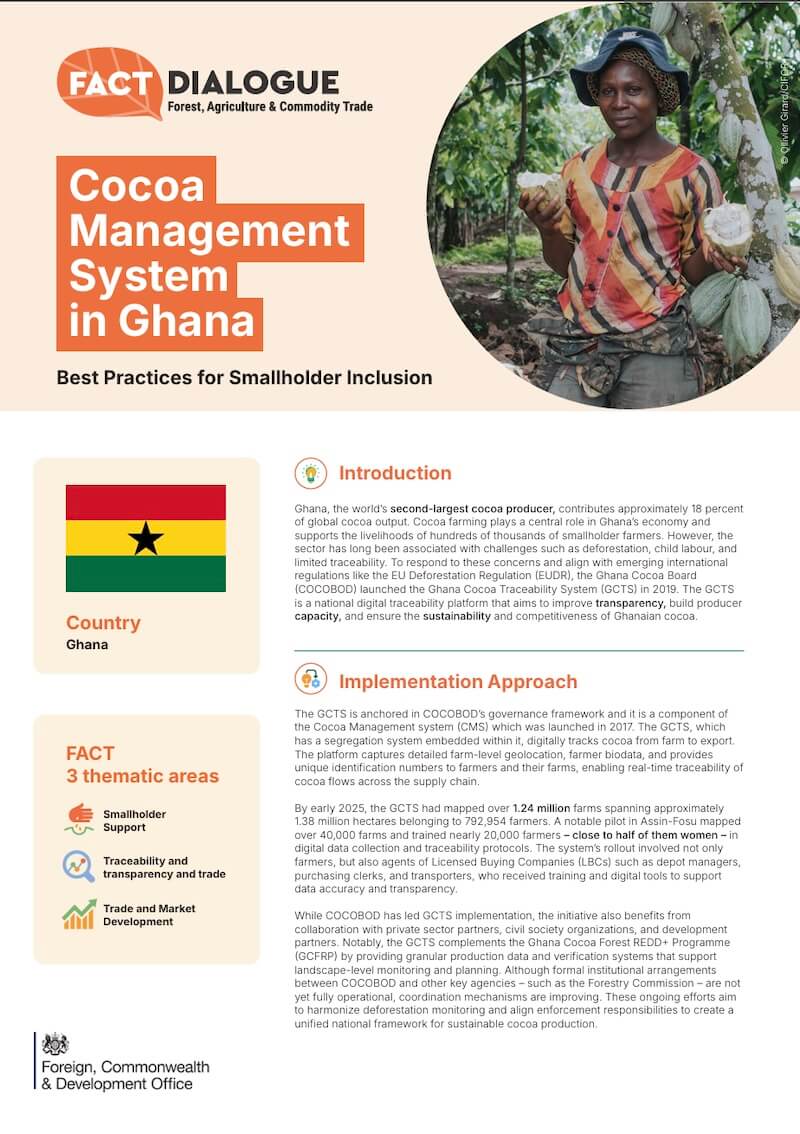
This case study documents how the Ghana Cocoa Traceability System (GCTS) integrates farm mapping, producer training and risk analytics to move national cocoa supply towards full traceability.
This case is significant because Ghana is one of the world’s largest cocoa producers, and smallholder farmers dominate its cocoa sector. Building a robust traceability infrastructure helps Ghana meet growing international demand for deforestation-free cocoa.
However, maintaining accuracy in farm maps, updating risk data, and sustaining training programmes for often remote farmers are non-trivial tasks. There is also the risk that the costs of system participation could exclude the poorest growers unless supported by public or private funding.
1.24 million
farms mapped
High Forest Zone, Ghana
792,954
farmers registered
National farmer identification system
~350,000
farmers trained
Farm mapping, farmer ID systems, risk analytics and supply chain tracking
3
FACT pillars advanced
Traceability and Transparency | Smallholder Support | Trade and Market Development
7
years of implementation
Embedding traceability across Ghana’s cocoa value chain
In practice: National cocoa rollout
Launched by the Ghana Cocoa Board (COCOBOD), the GCTS is embedded within the national Cocoa Management System (CMS). The platform assigns unique identifiers to farmers and geolocates farms, digitally tracking cocoa from production to export.
Licensed buying companies, depot managers and transporters are trained and equipped with digital tools to ensure supply chain data accuracy. Risk analytics detect deforestation alerts, child labour risks and yield anomalies, enabling early intervention and compliance monitoring.
Why this matters
Ghana’s GCTS demonstrates how a producing country can institutionalize traceability at national scale.
By combining farm mapping, farmer capacity building, and market readiness within a single system, the initiative strengthens supply chain transparency while supporting smallholder inclusion.
In doing so, it advances FACT priorities on traceability, market access and sustainable, deforestation-free commodity production.