Year of publication
2025
Location
Cameroon (Headquarters of FODECC in Yaoundé; cocoa and coffee production basins)
Financial supporter:
National cocoa/coffee levy (~EUR 12 million per year) and a USD 20 million CAFI project (2024–2027) implemented by IFAD
Period of implementation:
FODECC ongoing; CAFI‑IFAD support 2024–2027
Commodities:
Cocoa and coffee
Initiator:
Government of Cameroon via FODECC
Author & Publisher
FACT DIALOGUE
Overview
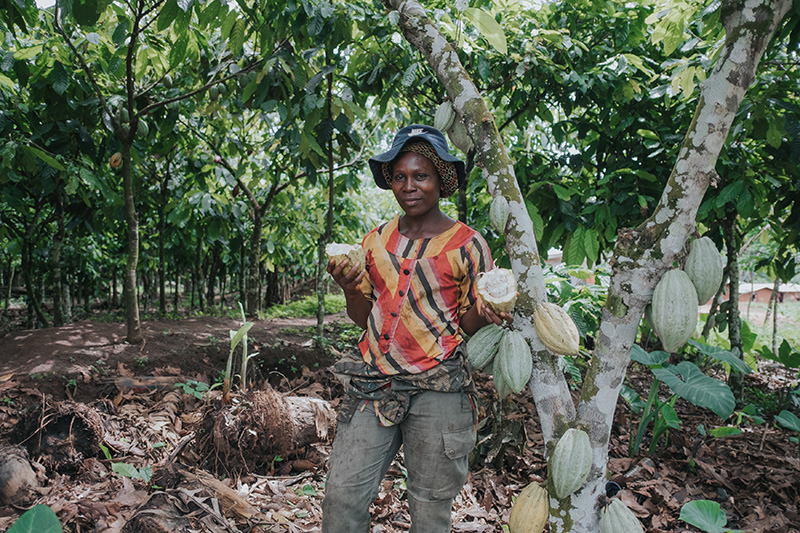
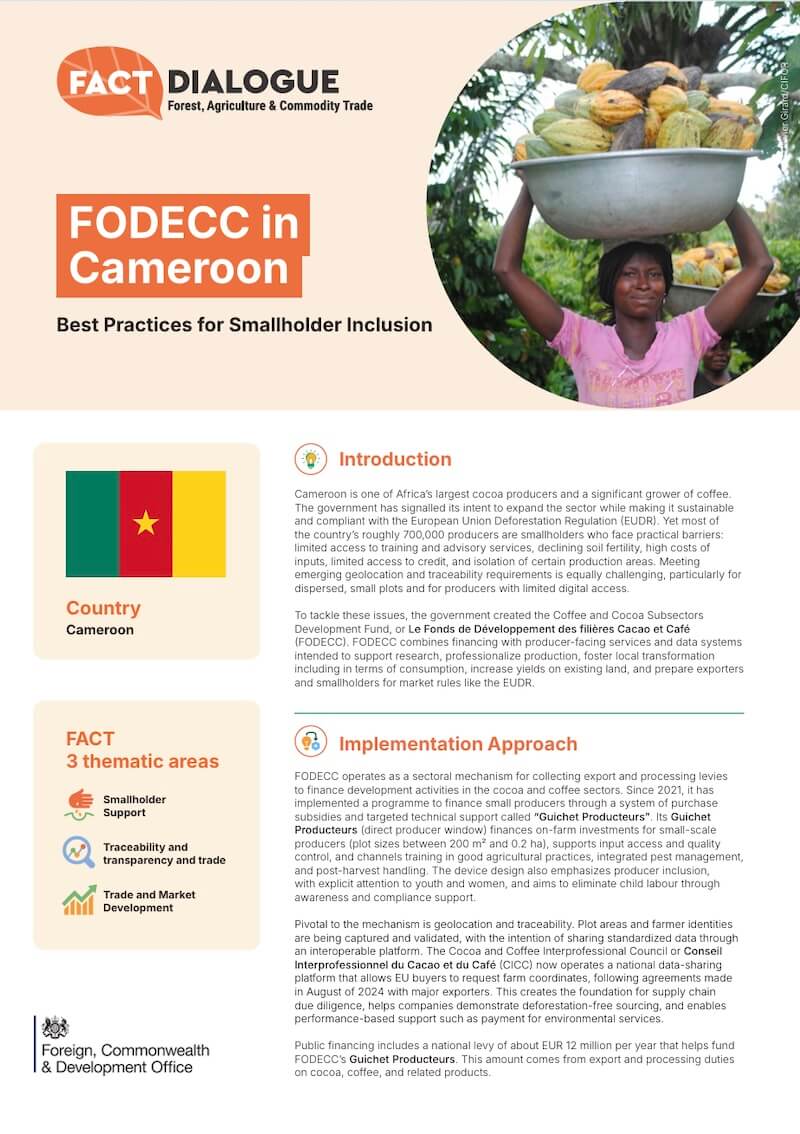
This case study examines how Le Fonds de Développement des filières Cacao et Café (FODECC) in Cameroon integrates geolocation, bundled producer services and levy-backed financing to make due-diligence compliance workable for cocoa and coffee smallholders.
FODECC is compelling because it is not simply a fund – it is a sector-wide mechanism that strengthens environmental and social sustainability by improving traceability, professionalizing production, and investing in smallholder capacity. By linking data, services and market incentives, FODECC transforms abstract compliance requirements into actionable support.
However, long-term success depends on stable levy revenues, farmer trust, uptake of services and robust verification systems to ensure measurable impact.
240,000+
producers enrolled
Through the Guichet Producteurs window (target 300,000 by 2025)
EUR 12M
annual levy funding
Supports technical services, input access, and advisory for smallholders
2
supporting frameworks
Guichet Producteurs + Agroecological Transition Window
3
FACT pillars advanced
Trade and Market Development | Smallholder Support | Traceability and Transparency
5
years of implementation
Linking compliance, advisory, and market readiness
In practice: Mapping data into actionable support
FODECC captures plot geolocation and farmer identity for 240,000 producers. Through the Guichet Producteurs window, this data is converted into targeted support: advisory visits, safer input access, training on good agricultural practices, pest management, post-harvest handling and performance-based incentives such as payment for environmental services.
Coordination with exporters and ministries ensures that compliance with the EU Deforestation Regulation (EUDR) is feasible for smallholders, while youth and women receive explicit inclusion support. By tying data to tangible benefits, FODECC moves from mapping to measurable outcomes on the ground.
Why this matters
Cameroon’s FODECC demonstrates how a national mechanism can professionalize smallholder cocoa and coffee production while meeting international due-diligence requirements. By combining financing, advisory services, data systems and coordination, it strengthens traceability, supports smallholders, and promotes sustainable trade practices.
This integrated approach mirrors the logic of the FACT Roadmap: mapping unlocks benefits, service delivery lifts quality and yields, and alignment with regulations like the EUDR ensures deforestation-free sourcing. If Cameroon maintains inclusion, coordination and service quality, it offers a practical model for other countries seeking to align smallholder support with environmental and market compliance.