Year of publication
2025
Location
Implementation in Peru with Germany as lead implementer
Financial supporter:
BMUKN through the Export Initiative for Environmental Protection (EXI)
Period of implementation:
2023–2025
Commodities:
Coffee
Initiator:
ForestGuard was initiated by the Sustainable Finance Advisory Committee of the German Federal Government in the framework of joint Peru–Germany cooperation under BMUKN’s “Export Initiative for Environmental Protection” (EXI) funding programme
Author & Publisher
FACT DIALOGUE
Overview
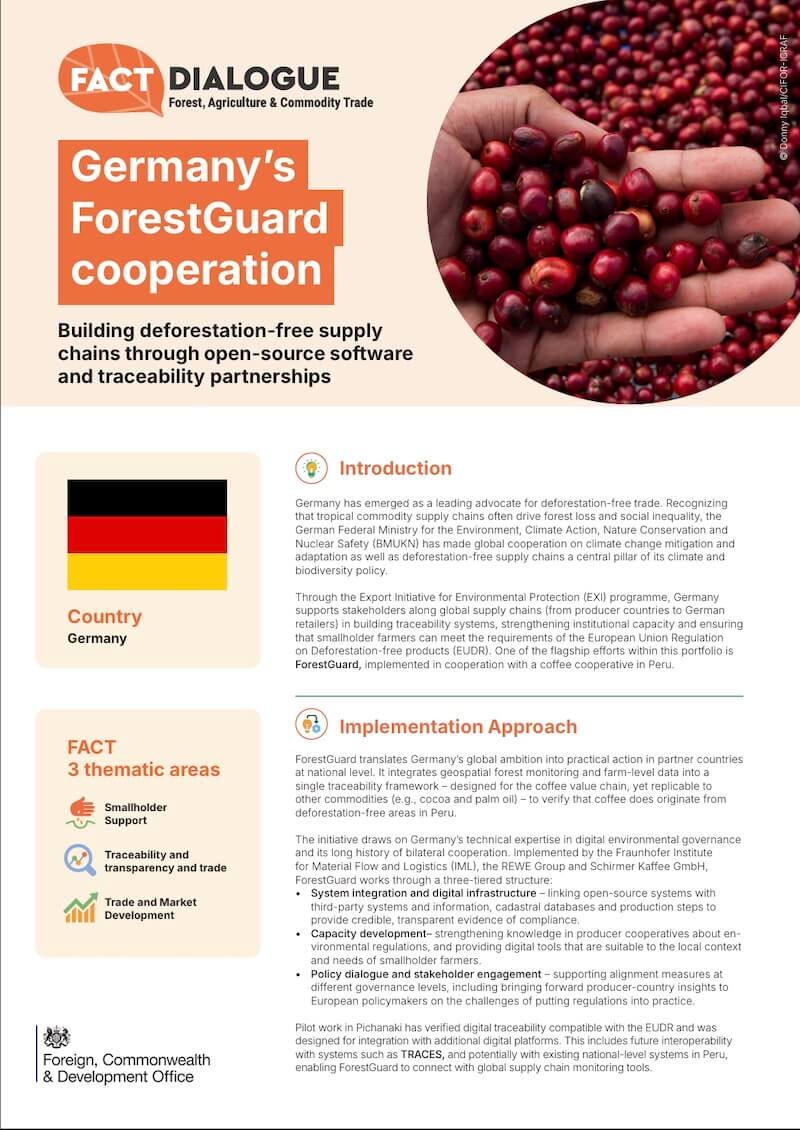
This case study details how the ForestGuard project developed an open-source, blockchain-based software to help companies and smallholder coffee farmers in Peru comply with the EUDR by enabling transparent, verifiable supply-chain data exchange.
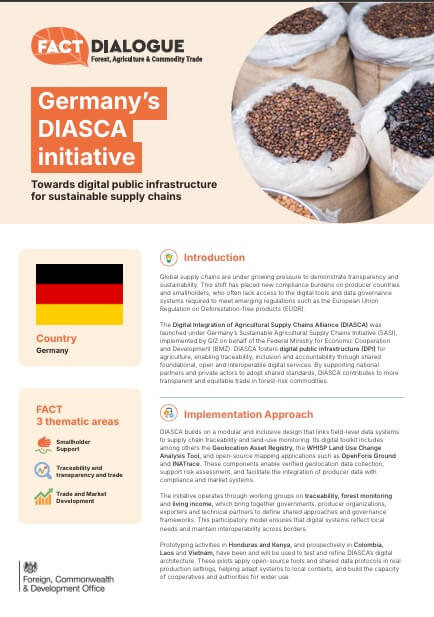
Additionally, the case study focused on the Digital Integration of Agricultural Supply Chains Alliance (DIASCA) explains how partners jointly work on an open digital public infrastructure (DPI) to make agricultural supply chains traceable, inclusive and sustainable.
These German-led digital initiatives showcase the potential of public-good technology for supply chain transformation. By using open-source tools, they lower the barrier to entry for small actors, foster interoperability, and promote data sharing. But challenges remain, including ensuring data quality, maintaining farmer engagement, and protecting sensitive information, especially when scaling across geographies and commodities.
1
open-source EUDR-aligned traceability system piloted
Integrating geospatial forest monitoring with farm-level supply chain data
600
smallholder coffee farmers engaged
Building compliance readiness in Peru
3
implementation pillars
Digital infrastructure | Capacity development | Policy dialogue
2
years of implementation
Designed for replication across commodities and countries
3
FACT pillars advanced
Traceability and Transparency | Smallholder Support | Trade and Market Development
In practice: From geodata to due diligence
ForestGuard connects farm-level geodata, forest monitoring and supply chain records into a single EUDR-compatible traceability system.
Implemented with the Fraunhofer Institute for Material Flow and Logistics (IML), REWE Group, Schirmer Kaffee GmbH and a 600-member coffee cooperative in Peru, the pilot verified an open-source model designed for interoperability with EU systems such as TRACES and adaptable to national platforms.
By integrating data systems, ForestGuard lowers compliance costs while building smallholder readiness.
Why this matters
ForestGuard shows how a consumer country can pair regulation with implementation support.
By combining digital infrastructure, producer capacity building and policy dialogue, Germany reduces the risk that smallholders are excluded from deforestation-free markets.
It demonstrates that credible supply chains depend not only on rules, but on interoperable systems and equitable cooperation – advancing all three pillars of the FACT Roadmap.