Year of publication
2025
Location
Malaysia (national programme; oil palm landscapes)
Financial supporter:
Government of Malaysia; public incentives for audits and equipment; partner financing for replanting support
Period of implementation:
2015 to present; MS 2530:2022 effective since 2022 and mandatory from 2025
Commodities:
Oil palm
Initiator:
Government of Malaysia
Author & Publisher
FACT DIALOGUE
Overview
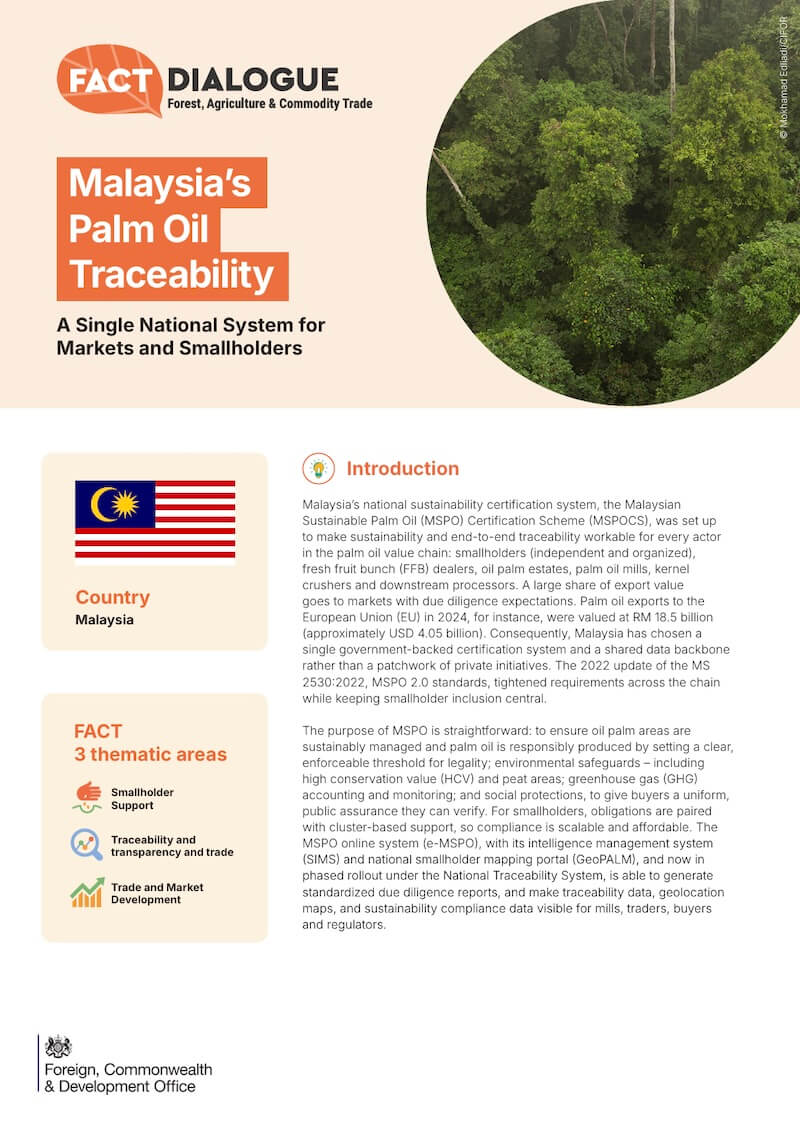
This case study examines how Malaysia’s national palm oil certification system (MSPO) operationalizes sustainability and traceability, showing how a single government-backed standard integrates smallholders into verified, market-compliant supply chains through a shared data backbone.
MSPO demonstrates how national-level regulation can meet global market demands: its government backing gives legitimacy and scale, while the data backbone helps smallholders participate in a system that would otherwise be costly or complex.
However, achieving radical sustainability improvements depends on enforcement, capacity building for smallholders, and international market recognition.
5.13
million hectares certified
Smallholders, estates, and mills under MSPO
162
Sustainable Palm Oil Clusters (SPOCs)
Cluster-based smallholder onboarding and support
90%
planted area covered
Verified compliance with MSPO standards
3
FACT pillars advanced
Traceability and Transparency | Smallholder Support | Trade and Market Development
11
years of implementation
Embedding traceability, compliance, and market readiness into daily operations
In practice: From standard to field-level delivery
MSPO operationalizes traceability and sustainability by connecting smallholders to cluster-based services and real-time data systems. Producers are registered in SPOCs and KPSM cooperatives, onboarded with coaching and verification of land, licenses and yields, and supported through training and audit preparation.
The eMSPO system links records from mills, buying points and clusters into a single ledger, keeping certificate status, corrective actions and traceability logs visible to auditors, buyers and regulators. Meanwhile, GeoPALM maintains up-to-date smallholder profiles with geolocated plots, enabling planning for audits, extension support and replanting.
These linked elements reduce administrative burden for smallholders, ensure compliance aligns with everyday operations, and connect field-level practice to market verification.
Why this matters
Malaysia shows how a national standard can turn sustainability policy into practical, verifiable routines for millions of smallholders. By bundling traceability, cluster services and digital oversight, MSPO ensures compliance is feasible, scalable and linked to market access.
This integrated approach aligns with the FACT Roadmap pillars on Trade and Market Development, Smallholder Support, and Traceability and Transparency, offering a model for other smallholder-dominant commodities where enforcement, inclusion and data coherence are critical for sustainable supply chains.