Year of publication
2025
Location
The Netherlands
Financial supporter:
IDH, VNO-NCW, (possible future financial partners: Dutch ministries, private sector contributions)
Period of implementation:
2024–2028
Commodities:
All food and agricultural products traded to and from the Netherlands
Initiator:
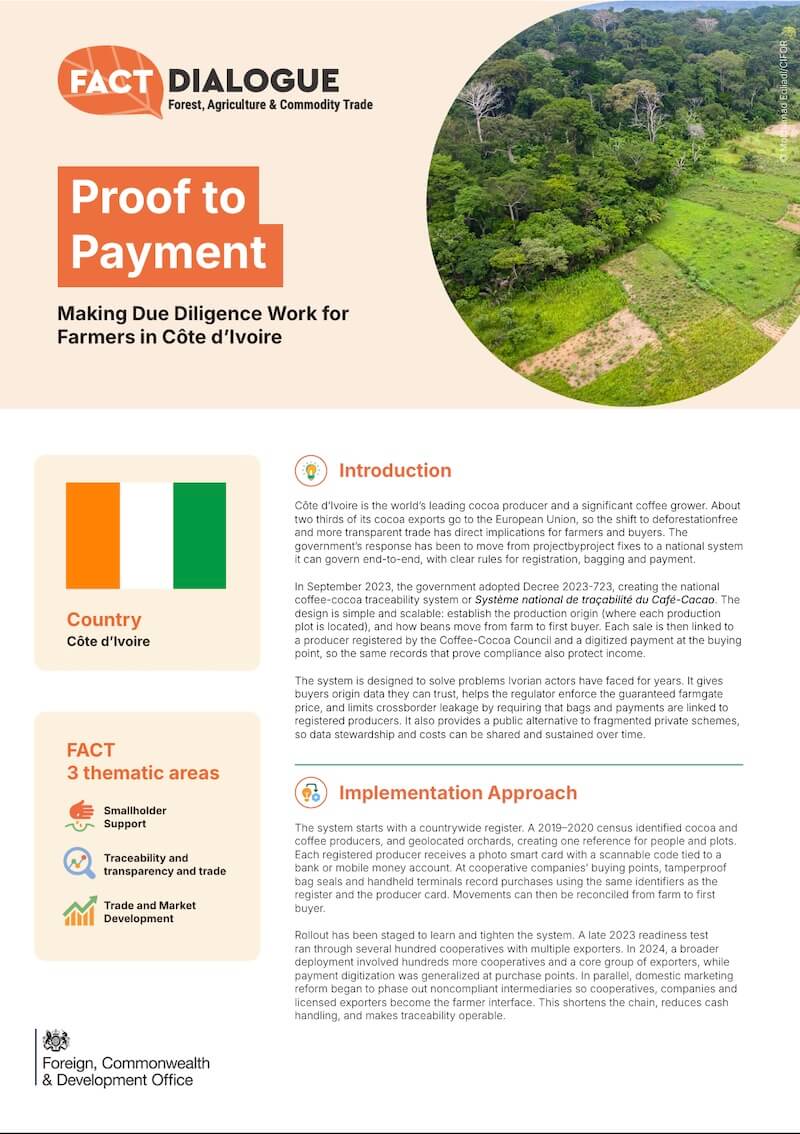
Multi-stakeholder initiative led by IDH and VNONCW with government partners
Author & Publisher
FACT DIALOGUE
Overview
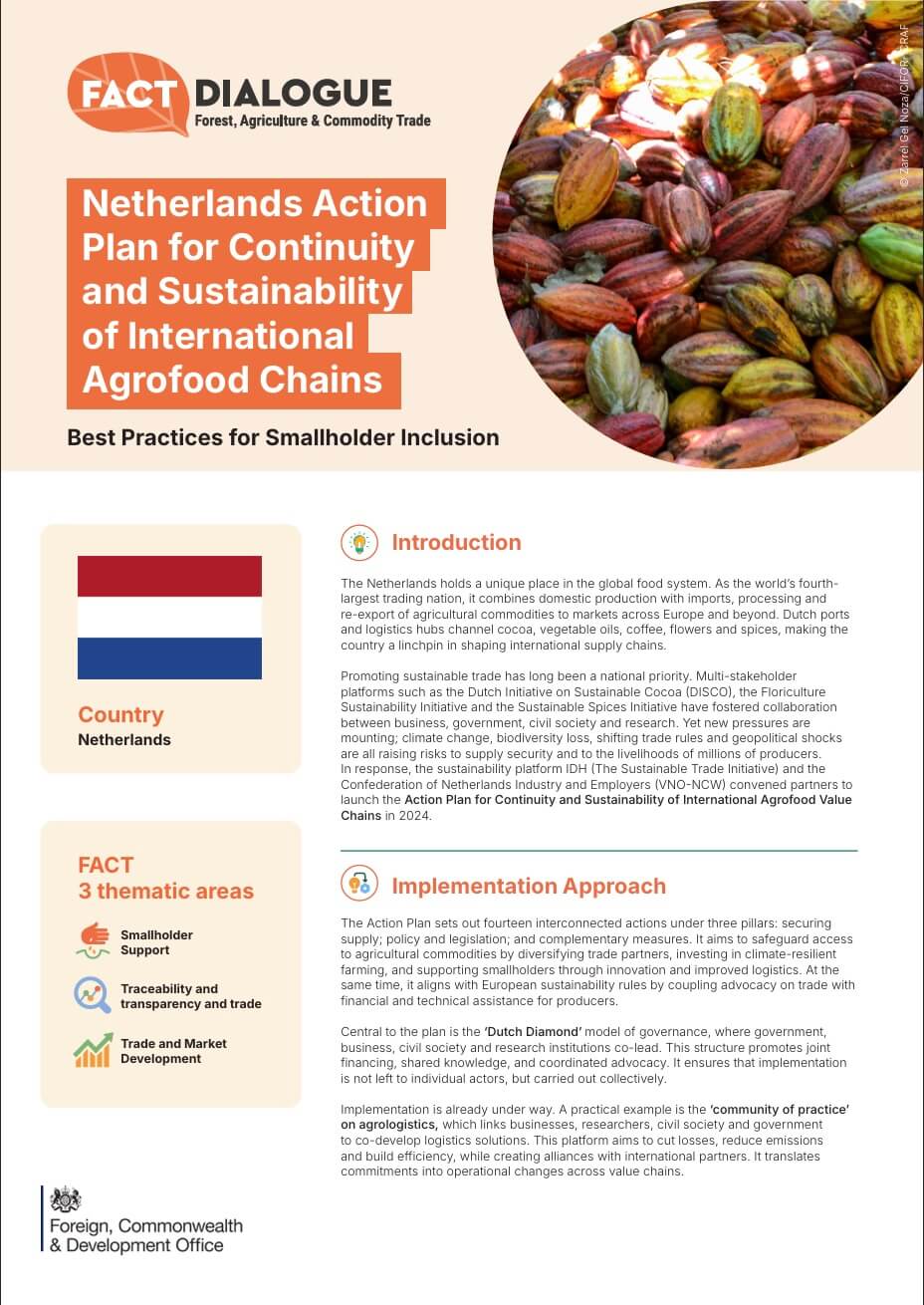
This case study examines how the Netherlands’ 2024 Action Plan for Continuity and Sustainability of International Agrofood Value Chains integrates trade security and sustainability, demonstrating how the country uses multi-stakeholder coordination as part of the Dutch ‘Diamond model’ to build resilient, deforestation-free and inclusive global supply chains.
This case highlights how a consumer country can leverage its trade power and institutional coordination to promote sustainability. By bringing together diverse stakeholders, the Netherlands fosters shared responsibility and long-term commitment.
However, such models require trust, transparency and power-sharing – and successful implementation depends on aligning incentives across sectors, particularly when smallholders in producer countries may not have the same voice or resources.
4th
largest trading nation globally
Major hub for cocoa, coffee, vegetable oils, flowers and spices
14
interconnected actions
Across supply security, policy and legislation, and complementary measures
3
FACT pillars advanced
Trade and Market Development | Smallholder Support | Traceability and Transparency
2024–2028
implementation period
Integrating resilience and sustainability into national trade policy
‘Dutch Diamond’ model
Multi-stakeholder governance
Government, business, civil society and research co-lead implementation
In practice: From risk analysis to coordinated delivery
The Action Plan translates resilience goals into operational mechanisms. One early step was the development of a national compendium of supply risks, followed by sector-specific analyses for commodities such as coffee and cocoa.
A practical example is the “community of practice” on agrologistics, which connects businesses, researchers, civil society and government to co-develop logistics solutions that reduce losses, cut emissions and strengthen supply reliability.
Through joint financing, shared knowledge and coordinated advocacy, the Dutch Diamond model ensures that sustainability and trade security are addressed collectively rather than by isolated actors.
Why this matters
The Netherlands demonstrates how a major trading hub can integrate supply security and sustainability within a single national framework.
By aligning trade policy, business coordination, risk monitoring and producer-country partnerships, the Action Plan strengthens market resilience while supporting smallholder inclusion and compliance readiness.
In doing so, it advances the FACT Roadmap’s pillars on trade and markets, smallholder support and traceability – showing how consumer-country coordination can reinforce deforestation-free supply chains at global scale.