Year of publication
2025
Location
Ancash, Cajamarca, Huánuco, Junín, Madre de Dios, Pasco, and San Martín
Financial supporter:
SERFOR and KfW
Period of implementation:
2024 to present
Commodities:
Timber from plantation species suited to zoned areas
Initiator:
SERFOR.
Author & Publisher
FACT Dialogue
Overview
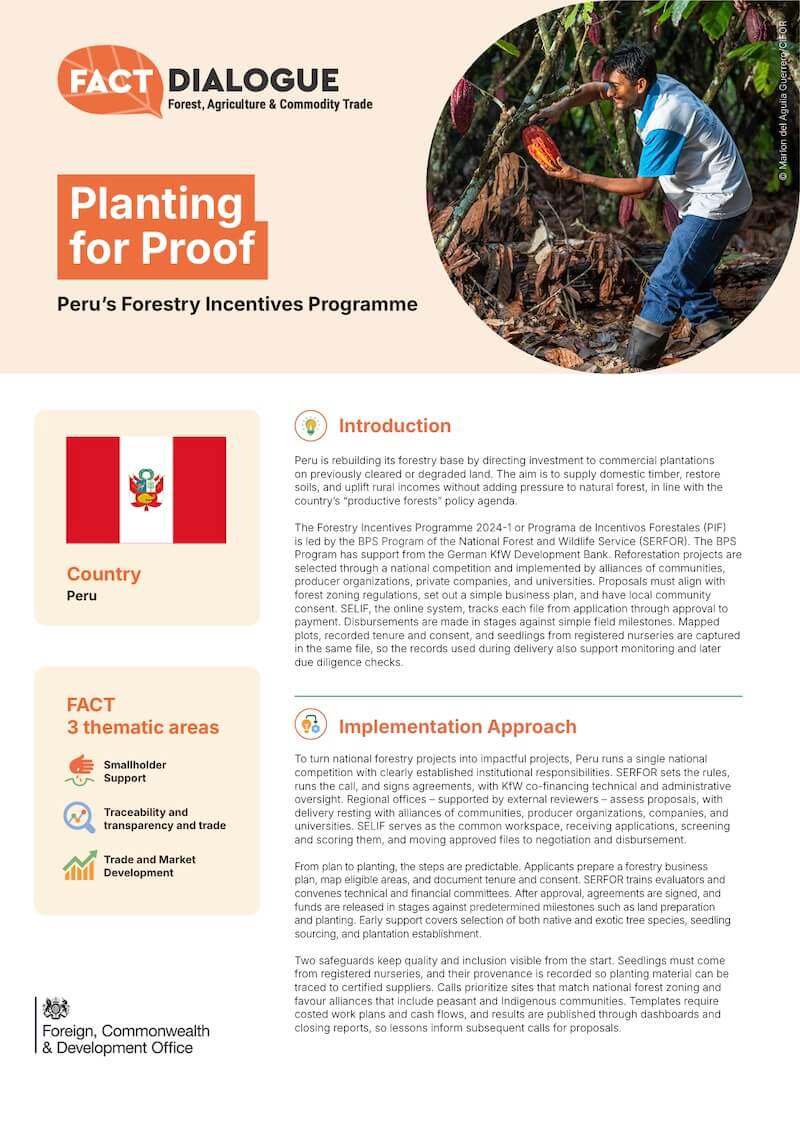
This case study traces how financial instruments, combined with rigorous zoning, tenure and consent verification, and seed provenance tracking, can incentivize forestry investment on pre-zoned, non-forested land.
Peru’s Forestry Incentives Programme (PIF), led by SERFOR with support from KfW Development Bank, aligns capital markets with conservation and restoration goals. By pre-zoning land and clarifying tenure, barriers to investment are significantly reduced, enabling investors to finance sustainable forestry production rather than speculative clearing.
The model integrates finance, governance safeguards and digital tracking through a national competition process and the SELIF online system, which follows projects from application through approval, disbursement and monitoring.
Challenges remain, including ensuring communities’ consent and equitable benefit sharing, maintaining robust provenance verification, and sustaining long-term incentives for investors to preserve natural ecosystems rather than convert them.
50
Projects selected
First national competition
6 regions
Geographic coverage
Ancash, Cajamarca, Huánuco, Junín, Madre de Dios, Pasco, San Martín
5,300 hectares
Plantation establishment
Pre-zoned, non-forested land
~7,000 households
Rural beneficiaries
Community and producer alliances
Pen 89 million
Programme envelope
Finance aligned with restoration and sustainable production
2
years of implementation
Directing forestry investment towards verified land use
In practice: From plan to planting
Applicants prepare a forestry business plan, map eligible areas, and document tenure and community consent before submission. Regional offices and technical committees assess proposals, and approved projects proceed to agreement signing.
Funds are released in stages against simple field milestones such as land preparation and planting. Seedlings must originate from registered nurseries, and their provenance is recorded to ensure traceability. The same documentation follows projects into monitoring and inspection.
Early verification in departments such as San Martín and Junín shows that tying disbursements to straightforward milestones improves implementation timelines and strengthens plantation establishment outcomes.
Why this matters
PIF shows how incentives can direct investment to suitable land while reducing pressure on natural forests.
By integrating zoning, tenure clarity, staged finance and digital records, compliance becomes part of standard project management rather than a parallel process.
The model demonstrates how plantation forestry on degraded land can support rural incomes, strengthen documentation for global markets, and advance deforestation-free value chains; directly contributing to the objectives of the Forest, Agriculture and Commodity Trade (FACT) Dialogue.