



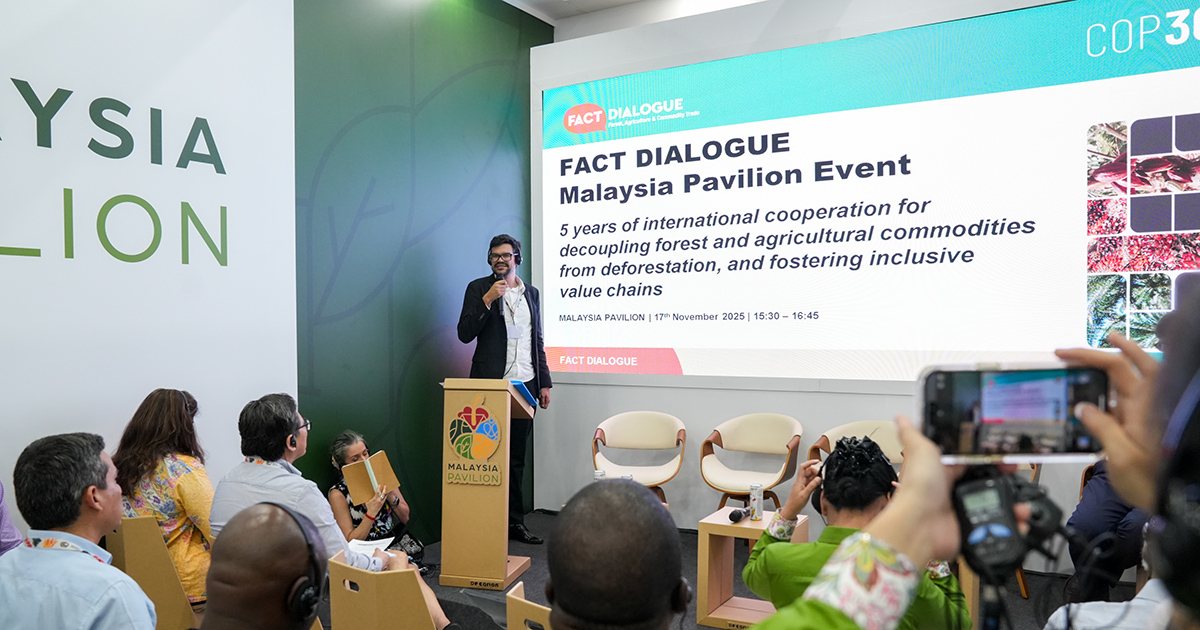
In 2025, the international community marked two milestones: ten years since the Paris Agreement under the United Nations Framework Convention on Climate Change and five years since the launch of the Forest, Agriculture and Commodity Trade (FACT) Dialogue at COP26 in Glasgow. This year’s COP30 in Belém — widely framed as “the forest COP”, with food systems high on the agenda — offered a timely moment to take stock.
Once again, the FACT Dialogue demonstrated its value as a collaborative platform among governments, bringing together major producer and consumer countries to advance sustainable trade, forest protection and smallholder inclusion.
At COP30, FACT released several key deliverables, including its 2025 progress report, 11 case studies, the Traceability & Transparency (T&T) paper and Trade & Markets (T&M) info brief. Echoing the COP30 Presidency’s global call for a ‘mutirão’— a Brazilian concept rooted in collective effort and cooperation towards a shared goal — the FACT Dialogue convened seven sessions in Belém, engaging both member countries and the FACT secretariat.
Across these exchanges, one message came through clearly: sustainable supply chains must protect forests, support livelihoods and propel inclusive climate action. This was reinforced in interventions by FACT co-chairs, the United Kingdom (UK) and Malaysia.
“Forests support not only the global climate system, but also rainfall patterns, agriculture, flood resilience, soil health and medicine supply,” said Ruth Davies OBE, UK Special Representative for Nature. Dr Teh Lian Tai, Head of Malaysia FACT Dialogue Secretariat emphasized the importance of international cooperation through dialogue to achieve the dual goal of leaving no forest — and no one — behind.
FACT’s presence at COP30 reflected both growing momentum and tangible progress. This combination of credibility, evidence and multi-country engagement set the tone for its work in Belém and beyond.
Smallholder inclusion at the heart of climate action
Smallholders continue to face persistent barriers, including limited access to finance, capacity constraints, digital literacy gaps, gender inequalities and insufficient technical support. At COP30, FACT placed these realities — and solution pathways — at the centre of its engagement.
A key contribution was the launch of 11 national case studies, documenting practical national initiatives identified by FACT member countries to advance smallholder inclusion, traceability and climate-aligned trade.
FACT-related events at COP30 included:
- AgriZone – “Leaving no one and no forest behind by enabling mutually beneficial transparency and smallholder inclusion in sustainable agri-food chains” (12 November).
- Coalition of Trade Ministers on Climate – Transforming forest-risk agricultural commodities: Inclusive, climate-resilient, and deforestation-free solutions” (14 November).
- Action Agenda — “Collaborative solutions for transparency in farming and forestry” (15 November).
- FACT & TESS — “Fostering International Cooperation on Trade, Sustainable Agriculture, and Deforestation: The Importance of Smallholder Inclusion in Sustainable Agri-Food Chains” (15 November).
- FACT Event at the Malaysia Pavilion — “5 years of the FACT Dialogue – Catalysing Sustainable Commodity Trade for Climate, Nature and Livelihood” (17 November).
The case studies showcased diverse national experiences, including:
- The UK Sustainable Commodities Initiative, a platform which aligns buyers, reporting and cross-commodity working groups to strengthen demand signals and traceability.
- Malaysia’s national palm oil certification system (MSPO) scheme, integrating 450,000 smallholders through people-centered, government-led programmes.
- Ghana’s Cocoa Management System, supporting 2.1 million farmers through digital traceability and governance tools.
- Brazil’s agroecology and productive-forest programmes, which build farmer capacity while protecting forests.
- Côte d’Ivoire’s social mechanisms and innovation to strengthen cocoa farmer livelihoods.
Women farmers were highlighted as a group needing tailored technical and social support. As Suranjana Gupta of the Huairou Commission noted, “Women need support not only in risk mapping, but also in organizing collectively and accessing technical knowledge.”
Together, these examples illustrate how government and community-led programmes, digital tools and social measures can work in concert to advance inclusive and sustainable commodity systems. FACT’s case studies point to concrete ways governments are supporting farmers through digital transparency tools along commodity value chains, restoring lives and landscapes, as well as advancing national certification schemes based on mutual recognition.
Toward mutually beneficial transparency and traceability
Panel sessions in Belém also provided an enabling space for FACT members to further exchange on the T&T paper: Promising Approaches by Governments to Strengthen Forest and Agricultural Traceability and Transparency Systems. Across COP30 sessions, delegates shared perspective on how governments can play a stronger role in the T&T space, while co-creating an enabling environment for mutually beneficial transparency.
Central to these discussions was the need to ensure that transparency systems include and equitably benefit all value chain actors, while fostering sustainable agriculture and supply chains that work for all peoples and forests. This message resonated across events at the Malaysia Pavilion and AgriZone, reaching a broad audience that included Party delegations, civil society organizations, private sector representatives, farmers and Indigenous Peoples.
Inclusive markets and sustainability certification as enablers
Discussions at COP30 increasingly recognized the role that sustainable and inclusive agricultural trade can play in advancing climate action while conserving biodiversity and forests. This perspective emerged during the Coalition of Trade Ministers meeting on 14 November and the FACT and TESS events on 15 November. Drawing on its trade and markets information brief, FACT highlighted the importance of policies that expand market access— particularly for smallholders and vulnerable groups — alongside incentives that encourage sustainable production and inclusive trade. Participants explored mutual recognition as a practical foundation for aligning production systems, markets and trade in ways that serve both people and the planet.
Further in-session dialogue surfaced the need for international recognition of credible national assurance systems and voluntary sustainability standards within evolving legislative frameworks aimed at achieving zero deforestation.
Looking ahead, FACT will continue to focus on turning dialogue into delivery, supporting countries to align national assurance systems, inclusive market incentives and international policy frameworks. The goal remains clear: to accelerate progress toward zero deforestation while leaving no one behind.